Historical Thinking Skills
HTS 1 Crafting Historical Arguments from Historical EvidenceReflection In order to be successful at developing historical thinking skills students must learn to evaluate texts written in previous time periods and be able to understand the claims being made by the author. Also they must be able to utilize the useful information and determine whether the author is credible and how this affects point of view. Throughout the school year I was able to develop this skill by creating SOAPSTONE charts for documents found in our textbook. SOAPSTONE requires you to read the document, identify the speaker which could possibly affect the point of view of the document, relate the document to what is occurring globally, distinguish the purpose of the document and analyze the tone of the speaker. Although, in my opinion I struggled to discover what the documents were attempting to do and how they specifically impacted a certain event. Nevertheless, reading documents and utilizing the charts helped me evaluate the credibility and point of view of an author more closely. Before I would simply believe any article I came across without taking in consideration if it was a primary source or the qualification of the author making the claims. This skill will aid me not only in my future courses but will also create a better reader out of me as I apply my new found knowledge on non-historical texts. Similarly, I will be able to comprehend a literary piece more thoroughly and extract the most useful fragments of information in order to draw appropriate conclusions. Evidence This picture demonstrates the format of a SOAPSTONE chart and all the components that creates its structure. In this particular SOAPSTONE I am comparing two documents found in the AP World History textbook. 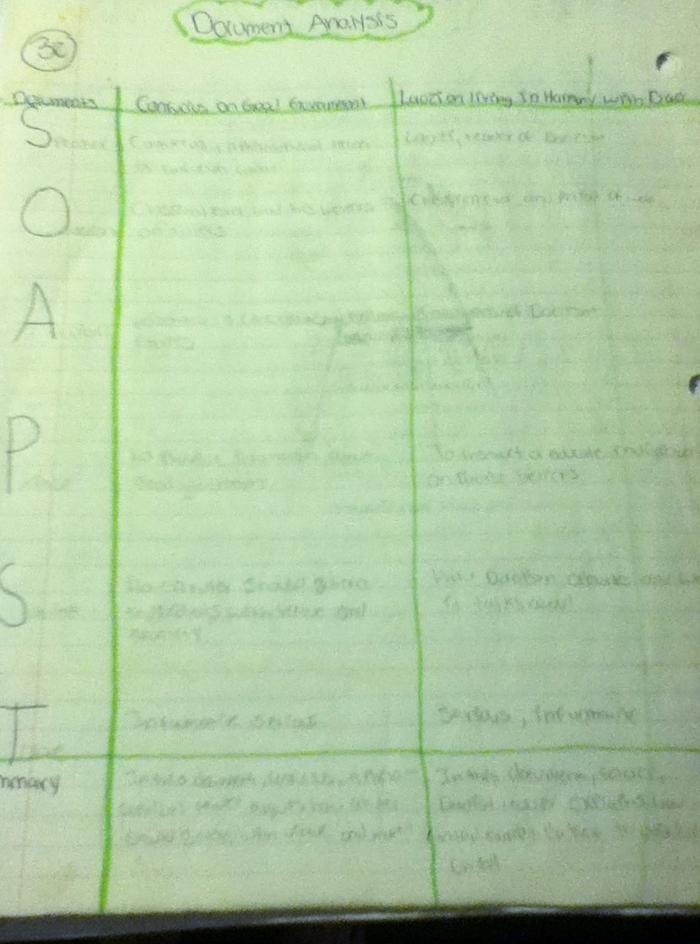 |
HTS 2 Chronological ReasoningReflectionThe understanding of history in chronological order is achieved when an individual is able to analyze continuities and changes in a specific time period. Also, one should be able to compare the time period with differing time periods and relate certain aspects from each other. In class I applied this skill when attempting to compose my Change Overtime essays. A change over time essay consists of receiving a prompt which asks you to analyze the changes and continuities from a period in history. It may be challenging to remember exact dates although a concept that was of great use to me while writing these essays was the Chinese Dynasty song. This song broke up history into pieces which corresponded with the dynasties and greatly simplified the writing process. Once you know in what time frame the dynasties were in power, you are able to connect what is happening in China to what is occurring globally. Writing change overtime essays in my perspective will allow any student to make sense of most events occurring in a time period and how these events contributed to developments in the modern world. When students successfully make these connections the skill has certainly been mastered. I have noticed that while utilizing this skill, I sometimes feel like a historian who is capable of conversing about human history for an infinite amount of time.Evidence |
HTS 3 Comparison and ContextualizationReflectionIn order for a student to successfully master the historical thinking skill of comparison, they must be able to describe, compare, and evaluate the developments occurring in a society to the developments of a differing society. They should also take in consideration the time frame and geographic location when applying the skill. During the course of the class, we were able to practice this skill by composing comparison essays. While writing comparison essays you are given a prompt which instructs you to compare two societies, the prompt can ask you to compare a SPICE element within your given societies. These essays test your ability to remember the important advancements made in specific regions or empires in the course of human history and explain how they differed or how they were similar. I acquired some practice as I attempted to write a decent comparison essay. While in the process of completing a comparison essay I frequently noticed that even though some societies greatly varied in their geographic and cultural background they shared various similarities. It is astounding to realize that our predecessors, the modern world, the future generations will somehow be so alike yet completely peculiar. Also, when comparing societies you get an insight about each culture, belief system, social organization, political structure and most importantly their legacy. I had the opportunity to compare various civilizations myself and sincerely this comparison helped me understand human history on a deeper more meaningful level. Overall, this skill for me was the easiest to utilize and elaborate on.Evidence I applied the comparison historical skill when attempting to create a comparison essay. In this essay I am comparing China and Egypt.
|

HTS 4 Historical Interpretation and SynthesisReflectionHistorical thinking skills are acquired as a student
utilizes the ability to describe, analyze and interpret past historical
sources. The student can fully master the skill by putting it to practice. For
example, in class I was able to develop this skill when writing DBQ’s. A DBQ is an essay in which you answer the
prompt using the set of documents provided. The documents are usually a primary
or secondary source and one must extract the useful information from the
documents such as the author’s point of view, the subject, purpose and occasion
in order to answer the question. The prompt you are given may ask you about a
topic you have no knowledge of but with the information provided in the documents
you have an opportunity to decipher the question. A good score on your DBQ can be achieved if
you are able to arrange the documents in groups and explain the need for an
additional document that will help you further answer the question. In my opinion, at times it is challenging to
comprehend the speaker’s credibility and what they are attempting to achieve
with their words. Although, practicing
this skill repeatedly has helped me analyze texts more profoundly and take in
consideration the background of the speaker. In a normal class, you do not learn these high
level thinking skills, whereas in AP World History you learn an array of skills
that you can apply in the classroom and in the outside world. Evidence When completing my DBQ essay I utilized this particular skill as evidenced by the provided link below.
|
